San Antonio properties face persistent pressure from subterranean termites (*Reticulitermes flavipes*) that nest deep underground to escape high summer temperatures. The region's geological transition—ranging from…
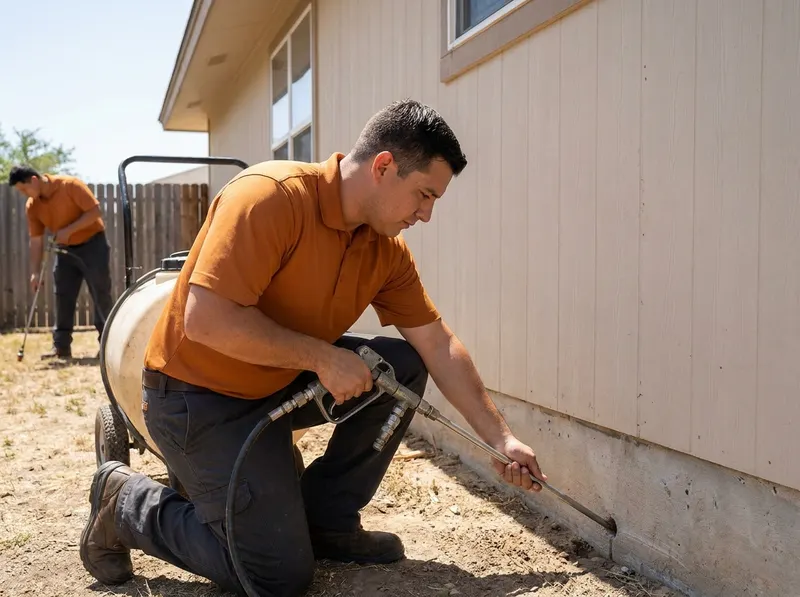
San Antonio properties face persistent pressure from subterranean termites (*Reticulitermes flavipes*) that nest deep underground to escape high summer temperatures. The region's geological transition—ranging from shifting Houston black clay in Southtown and King William to dense limestone outcroppings across Stone Oak, Timberwood Park, and Encino Park—causes foundation movement and microscopic hairline cracks. Termite colonies exploit these 1/32-inch foundation openings to build sheltered mud tubes into subfloors. A subterranean termite barrier treatment establishes an undetectable chemical boundary directly against the footing, ensuring foraging insects transfer the active termiticide back to the underground nest for complete colony elimination.
While localized bait stations rely on foraging termites randomly discovering plastic ground nodes over several months, a liquid chemical barrier delivers immediate physical containment along the entire structural perimeter. For historic pier-and-beam architecture in Monte Vista and Alamo Heights, technicians dig trenches around every interior pier and perimeter stem wall to block mud tube construction. For monolithic slab constructions typical in The Dominion and around the Medical Center, technicians rod-inject termiticide adjacent to exterior footings and drill discreet holes through attached patios. This comprehensive approach establishes long-term perimeter defense without requiring long-term structural modification.
Every job gets a firm, written price after a free on-site visit.
Tell us about your subterranean termite barrier treatment job in San Antonio and we'll send a clear, written quote — usually the same day.
 Velnaro Pest Defense Services